


Article summary:
- VoIP ROI isn’t just a cheaper phone bill. In 2026, the real win is fewer missed calls, faster responses, and less time wasted chasing people.
- Modern VoIP turns phones into a workflow tool. Auto-attendants, call queues, mobile apps, voicemail-to-email, and analytics can shave hours off the week.
- Predictable monthly costs help you plan. Lower hardware costs and fewer “we need a new box” panics.
- Provider choice matters as much as the platform. The right VoIP service provider prevents the hidden costs of bad call quality, a weak setup, slow support, and messy porting.
- Local support can protect your ROI. When something breaks, you don’t want to solely rely on a ticket number; you want and need an immediate fix.
If you’re a Maryland business weighing a phone upgrade, this article will show you what VoIP ROI actually looks like in the real world.
VoIP ROI in 2026: What the Business Case and Financial Benefits Really Mean
Most people hear “ROI” and think it’s only about dollars saved. I mean, sure, in the traditional sense, that’s what it means, because moving from a legacy PBX, PRI lines, or an aging hosted platform will certainly reduce costs. But in 2026, the bigger payoff is usually this: You stop paying for friction.
Friction looks like:
- Calls are going to voicemail because nobody knows who should pick up
- Customers are being forced to repeat themselves because call transfers fail
- Employees tethered to desks when they’re really needed on job sites, in the warehouse, or at home
- An unofficial “phone person” who becomes the help desk every time the system acts weird
- Expensive downtime when a box in the closet decides today is the day it waves goodbye and retires
The complete VoIP return on investment is what you get back when those headaches shrink or disappear altogether, and your team starts moving faster.
The Three Buckets of VoIP Return on Investment
Most VoIP cost analysis spreadsheets only measure the first bucket, which is cost savings. Again, it’s an important business metric, and that’s why businesses upgrade, but it’s not the whole story, and they wonder why down the road it doesn’t feel like a win.
1) Cost savings: what you stop paying for
This includes:
- Expensive PRI and legacy line costs
- Maintenance contracts
- On-site PBX repairs and replacement parts
- Big upgrade events every few years
With modern VoIP, pricing is typically per user/per month, and the range many SMBs see is often about $10–$30 per user/month, depending on features and setup. The point isn’t the exact number, but it’s in the monthly predictability. If you’re tired of surprise invoices, that alone can be a meaningful ROI.
2) Operational ROI: increased productivity and customer satisfaction
This is where ROI of unified communications starts to shine. Phones are no longer just phones, video conferencing isn’t siloed, and chat conversations aren’t lost or stuck with a single user.
They’re connected tools:
- Ring groups and smart routing so the right person gets the call
- Mobile and desktop apps, so remote and hybrid work isn’t a special case
- Voicemail-to-email so messages don’t die in a mailbox
- Call queues and after-hours routing so calls aren’t lost
- Basic reporting so you can spot missed calls and fix the leak
Time saved through system efficiency turns into money saved, even if it doesn’t show up as a line item tagged directly as VoIP-related.
3) Strategic ROI: flexibility and scalability
If we’ve come to learn anything, it’s that businesses change fast and need to stay nimble:
- Hiring comes in waves
- Locations shift
- Some roles go hybrid
- New services get launched
- Seasonal spikes happen (and phones get crushed)
The modern ROI of cloud PBX story is simple: add users fast, move numbers, adjust call flows, and don’t be forced to buy a new server. That agility is ROI, especially when change happens at the worst possible time, which is always.
A Realistic VoIP ROI Example, No Magic Fairy Dust Needed
Let’s use a simple, relatable scenario that’s a composite of what many small businesses run into:
You run a 25-person service business in Maryland (it could be HVAC, legal, home services, dental, property management, take your pick).
Your current setup sort of works, but:
- Customers complain they can’t reach anyone during peak hours
- Calls bounce around and land in a voicemail, not necessarily the right voicemail
- Two people on your team “know the phone system,” and everyone else just hopes
- When you hire, adding a new phone feels like a project
- If the internet hiccups, everyone panics
Here’s the difference when you upgrade to a modern VoIP system and also fix call routing:
- Calls go to a queue during busy times instead of voicemail
- Your scheduler can transfer calls cleanly
- Techs can answer from the mobile app when they’re between jobs
- After-hours calls route to an on-call rotation
- You start tracking missed calls weekly
What changes financially?
- You likely reduce legacy line and maintenance costs (hard savings)
- You stop losing leads to missed calls (revenue protection)
- You spend less payroll time on “phone chaos” (productivity)
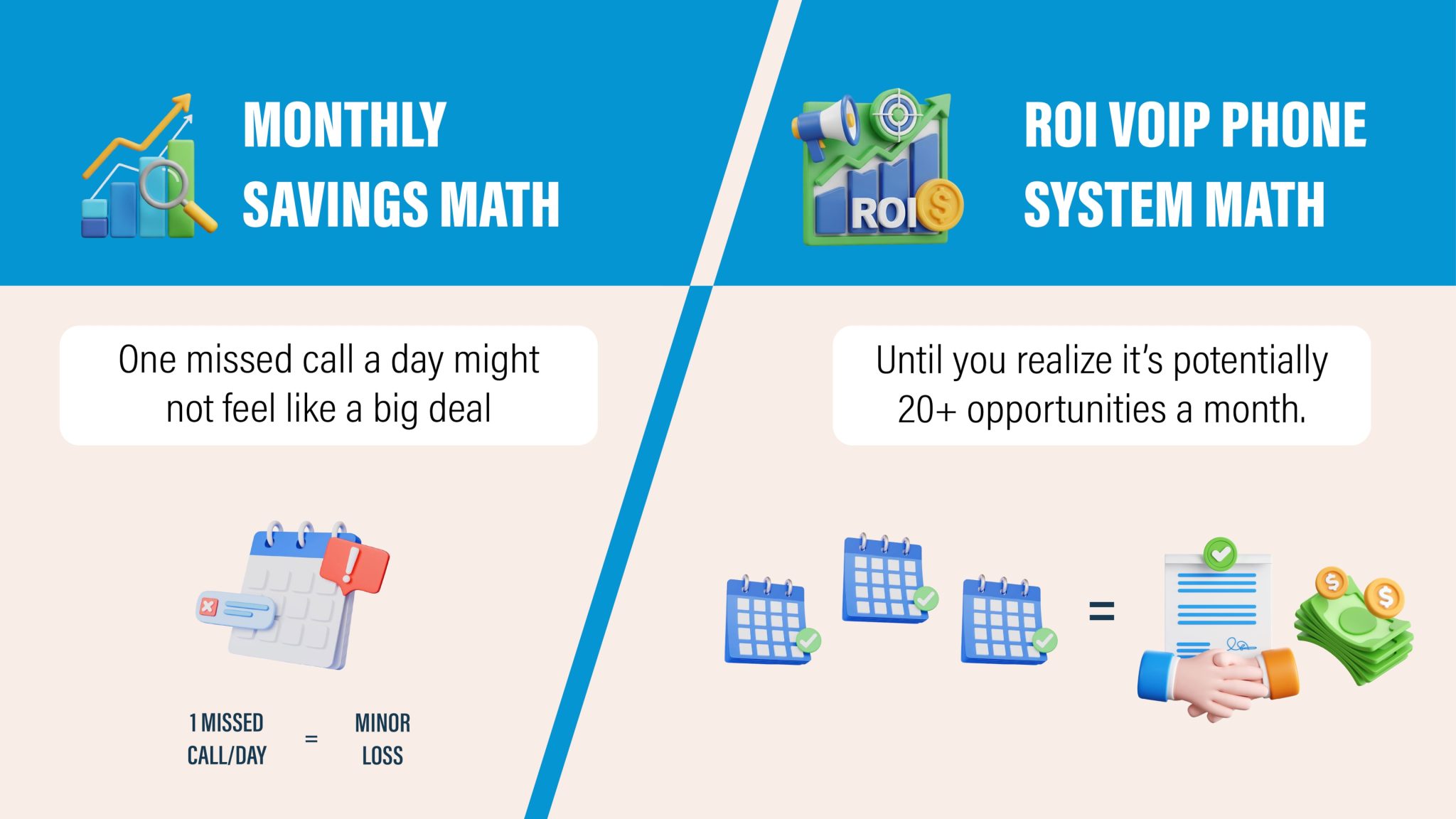
This is why ROI VoIP phone system math often beats monthly savings math. One missed call a day might not feel like a big deal until you realize it’s potentially 20+ opportunities a month.
The Hidden ROI Killer: Implementing VoIP and Picking the Wrong Provider
Here’s the part that’s hiding right below the surface: You can buy the most perfect technology and still get bad ROI if the rollout is sloppy and the support is nonexistent. A strong ROI VoIP service provider does more than hand you logins and ship phones. They protect you from costs no one inherently budgets for.
Hidden cost #1: poor call quality and blame games
Choppy audio and dropped calls will crush the spirit of your customers and employees.
A real provider checks:
- Network readiness and makes recommendations to bolster it
- Locks in the QoS (Quality of Service) network settings
- Firewall/router compatibility
- Proper configuration for your environment
Hidden cost #2: painful number porting and downtime
If porting isn’t managed well, businesses lose calls and patience. A good provider sets expectations, plans around critical dates, and ensures call forwarding and failover are in place.
Hidden cost #3: a system nobody uses correctly
If your team doesn’t understand the new tools, you don’t get the productivity ROI. Training matters. Simple documentation matters. And having a human you can call on matters.
Hidden cost #4: “cheap” pricing that grows teeth later
Some platforms look cheap until you add the features you actually need: call recording, analytics, mobile apps, SMS, integrations, etc.
Why Working with a Local Maryland Provider Matters
If you’re a Maryland-based business, working with a local provider can directly impact ROI.
Here’s why:
- Faster support when issues are urgent; you never want to hear the phrase “we’ll escalate your ticket”.
- Better understanding of local businesses. Many are multi-location, field teams, and front-desk heavy industries (we know how to work within all industries).
- On-site help when needed for installs, network upgrades, or training.
ACC Telecom positions itself as a long-term communications partner. That matters because a phone system isn’t a one-time purchase; it’s part of your daily operations. If you’re evaluating options, ACC Telecom needs to be on that list.
Objections Business Owners Have
“What if my internet goes down?”
Good question. A modern VoIP setup can include options like:
- Auto-forwarding to mobile phones
- Mobile/desktop apps that can switch networks
- Redundant connections, if uptime is mission-critical
Your provider should help you choose the right level of protection without overselling you.
“What are the initial costs, because we already bought phones?”
Often, you can reuse some hardware or mix desk phones with softphones/mobile devices. The ROI move is using what makes sense, not replacing everything just because.
“Switching sounds like a headache.”
It can be if it’s not managed properly. A solid provider handles planning, porting, configuration, and training so your team doesn’t have to figure it out mid-workday.
“Is cloud-based VoIP compliant for 911?”
For many businesses, yes, but it needs to be set up correctly. Federal rules around MLTS (Multi-line Telephone Systems) include direct 911 dialing, notifications, and dispatchable location requirements. That’s another “right provider = ROI” moment. Doing it right reduces risk.
What VoIP ROI Should Feel Like
If you upgrade and your only win is that the bill is lower, then undoubtedly you left a form of ROI on the table.
VoIP ROI in 2026 should feel like:
- Fewer missed calls
- Faster answers
- Easier hiring and scaling
- Less time wasted managing phone problems
- A system your team actually uses without complaints
And the biggest multiplier is who you choose to run it with. If you want a practical next step, explore ACC Telecom’s managed options for a modern cloud phone system. It’s built for growing Maryland businesses, and you can even compare packages on the cloud phone system pricing page. At the end of the day, we’re here to answer any questions you may have, so contact us to learn more.